TQC Micromotor TQC Micromotor

What Is an Electric Drive Motor and How Does It Work?

Time:2026-10-25 Author:Charlotte
0%

An Electric Drive Motor turns electrical energy into the controlled motion that moves a vehicle, machine, or industrial system. Unlike a traditional engine, it has no combustion chamber, fuel injectors, or exhaust pipe. Its essential parts are simple in concept: a stator creates a magnetic field, while a rotor responds to that field and produces torque. The inverter controls current, speed, and direction with remarkable precision.

Tesla engineer and CEO Elon Musk once said, “The most compelling thing about electric cars is that they are fun to drive.” That experience begins with immediate motor response. Press the accelerator, and the inverter rapidly changes the magnetic forces inside the motor. The wheels receive torque almost instantly. It feels smooth.

But smoothness does not mean simplicity.

Engineers must manage heat, vibration, insulation, software, and battery limits. During testing, infrared cameras may reveal hot areas around the windings, while sensors measure torque and rotational speed. Regenerative braking adds another layer. The motor temporarily works as a generator and sends energy back to the battery.

This article explains how an Electric Drive Motor works, from electrical input to mechanical output. It also examines induction motors, permanent-magnet motors, efficiency, cooling, and control systems. Real performance depends on the complete system, not the motor alone. That point is easy to overlook. A powerful motor can still perform poorly when its inverter, battery, or thermal design is inadequate.
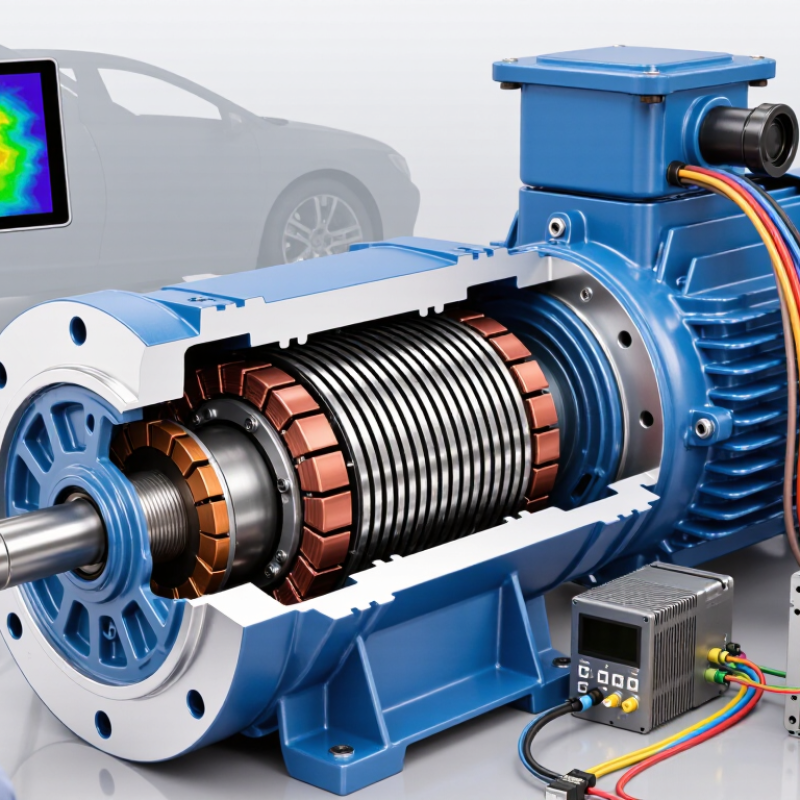
What Is an Electric Drive Motor and How Does It Work?

Definition and Core Components of an Electric Drive Motor

An electric drive motor converts electrical energy into wheel motion. It receives controlled current from an inverter, then creates a rotating magnetic field. This field pushes the rotor around the stator. The rotor connects to a reduction gear and differential, which deliver torque to the wheels. Simple in principle. Precise in practice.

The core components include the stator, rotor, windings, magnets, bearings, housing, sensors, and cooling system. The inverter adjusts voltage and frequency within milliseconds. Position sensors report rotor speed and angle, while temperature sensors protect the windings from overheating. Liquid cooling often circulates through channels near the stator. That detail matters during climbing, towing, or repeated acceleration. A motor can be compact, yet thermal limits remain real.

The International Energy Agency reported nearly 14 million electric car sales in 2023, representing about 18% of global car sales. The U.S. Department of Energy states that electric vehicles typically convert over 77% of grid energy into wheel movement. Conventional vehicles convert roughly 12% to 30%. However, efficiency figures depend on temperature, speed, road load, and charging losses. A simplified diagram can mislead. It may show torque appearing instantly, while real systems balance traction, heat, noise, and battery protection. Engineers still refine these compromises.

How Electrical Energy Produces Mechanical Motion

What Is an Electric Drive Motor and How Does It Work?
How Electrical Energy Produces Mechanical Motion

An electric drive motor converts electrical energy into mechanical motion. Current enters coils arranged around a stationary section called the stator. The current creates a changing magnetic field. That field pushes against magnets or energized coils on the rotor. The rotor then turns around its shaft.

The process is easier to picture with a small fan. Electrical current reaches the motor windings, magnetic forces develop, and the blades begin rotating. A controller adjusts voltage and current to regulate speed and torque. In practical testing, a motor may start quietly, then produce a low hum as the load increases. Heat is also important. Excessive current can damage insulation and shorten service life.

The rotor’s turning force travels through gears, belts, or a direct shaft connection. This motion can drive wheels, pumps, compressors, and industrial equipment. Sensors may measure position, temperature, or speed, allowing the controller to correct operation quickly. The explanation sounds simple, but real motors are less tidy. Friction, vibration, electrical resistance, and imperfect cooling all reduce efficiency. Small design errors can become noticeable under heavy loads. Testing under realistic conditions remains essential, even when calculations appear convincing.

The Main Types of Electric Drive Motors

An electric drive motor converts electrical energy into controlled mechanical motion. A power converter regulates voltage, current, and frequency. The motor then produces torque at the shaft. In a vehicle, that torque turns the wheels through a gearbox or direct drive system. Temperature sensors and position feedback help the controller protect the motor during acceleration, braking, and climbing.

The main types differ in rotor construction and control method. Induction motors use electromagnetic fields to induce current in the rotor. They are durable and tolerate demanding conditions, but their efficiency can drop at certain speeds. Permanent magnet synchronous motors use embedded magnets and usually deliver strong torque from a compact housing. They work efficiently, although heat can weaken magnet performance and increase design complexity. Switched reluctance motors use a simple rotor without windings or magnets. This design handles high temperatures well, but torque ripple and acoustic noise remain practical concerns.

Brushless DC motors resemble permanent magnet motors, yet their control signals often use a different waveform. They are common in pumps, fans, tools, and small electric systems. Engineers select a motor after checking load torque, speed range, cooling, cost, and control requirements. No single type wins every application. A quiet prototype may perform differently after dust, vibration, or repeated overloads appear. That gap between laboratory results and field operation deserves careful testing.

Key Control Systems and Operating Principles

An electric drive motor converts electrical energy into controlled mechanical rotation. Its operation depends on coordinated hardware and software, not the motor alone. A power converter shapes battery or grid voltage into timed current pulses. These pulses create a rotating magnetic field inside the stator. The rotor follows that field, producing torque at the shaft. Speed changes when the controller adjusts frequency, voltage, or current. Torque responds mainly to current, while speed reflects field timing and mechanical load.

At the center, a controller measures position, current, voltage, and temperature. Sensors provide feedback every few milliseconds. The controller compares actual behavior with requested torque or speed. It then corrects errors through pulse-width modulation and current regulation. A position sensor can improve starting accuracy and low-speed control. Sensorless estimation reduces hardware, but it may struggle during startup. Protection logic limits current, detects overheating, and disconnects power during faults.

During acceleration, torque rises carefully to prevent wheel slip or mechanical shock. During deceleration, the motor can act as a generator and return energy through the converter. Braking control must respect battery limits and traction conditions. Thermal management matters because resistance increases as windings heat. In field testing, tuning is rarely perfect. A noisy sensor or delayed command can cause vibration. That detail is easy to miss. Engineers refine gains, filters, and limits using measured data rather than assumptions.

Common Applications and Performance Considerations

What Is an Electric Drive Motor and How Does It Work?

An electric drive motor converts electrical energy into controlled mechanical motion. A controller regulates current through windings, creating a rotating magnetic field. This field produces torque at the shaft. In practical systems, sensors report speed and position, allowing the controller to adjust power within milliseconds.

These motors appear in electric vehicles, conveyor systems, pumps, fans, elevators, and automated machines. An electric vehicle may need strong torque during a quiet launch, while a factory pump often demands steady speed for many hours. Robotic joints require rapid changes and accurate positioning. HVAC equipment usually values smooth operation and low energy use. The application shapes the motor choice.

Performance depends on more than rated power. Engineers check starting torque, operating speed, efficiency, thermal capacity, duty cycle, and acoustic noise. Heat is a serious limitation. A compact motor may perform well briefly but lose output after repeated heavy loads. Not ideal. Cooling paths, airflow, mounting space, and ambient temperature all affect reliability. In field testing, vibration and dust can reveal problems that laboratory figures miss. I have also seen efficiency targets overlook control losses at partial load. That deserves another review. Good selection matches real operating conditions, not only the highest specification.

What Is an Electric Drive Motor and How Does It Work?

Electric drive motors convert electrical energy into controlled mechanical motion. Power electronics regulate voltage, current, frequency, speed, and torque so the motor can operate efficiently across different applications.

The values show representative operating efficiency levels for common electric drive motor applications. Actual efficiency varies with motor size, load, speed, cooling, inverter losses, and control strategy. Peak efficiency is commonly reached near the motor’s rated operating region.

FAQS

What does an electric drive motor do?

It converts electrical energy into wheel movement. Current creates a rotating magnetic field inside the stator. The rotor follows this field and produces shaft torque. Simple in theory. More complex in traffic.

Which parts are essential to the motor system?

Key parts include the stator, rotor, windings, magnets, bearings, housing, and sensors. A cooling system removes heat from important areas. A reduction gear and differential transfer torque to the wheels. Each part affects performance.

How does the inverter control motor speed?

The inverter changes voltage, frequency, and current within milliseconds. These adjustments create timed electrical pulses. Higher current usually increases torque. Field timing mainly influences speed.

What information do sensors provide?

Position sensors measure rotor angle and speed. Temperature sensors monitor winding heat. Current and voltage sensors support control decisions. The controller uses this feedback every few milliseconds.

Why is cooling important during demanding driving?

Heat increases winding resistance and can reduce efficiency. Liquid cooling often flows through channels near the stator. Climbing, towing, and repeated acceleration create extra heat. Compact does not mean heat-proof.

How efficient are electric drive systems?

Electric vehicles can convert over 77% of grid energy into wheel movement. Traditional systems often convert about 12% to 30%. Actual results vary with speed, temperature, road load, and charging losses. The number is useful, but never the whole story.

Can the motor recover energy during braking?

Yes, the motor can operate as a generator during deceleration. It sends some energy through the converter toward the battery. Recovery depends on battery limits and tire traction. Not every braking moment returns the same amount.

What problems can occur in motor control?

A noisy sensor or delayed command can cause vibration. Sensorless control may struggle during startup. Poor tuning can also create unwanted sound or uneven response. Engineers adjust gains, filters, and limits using measured data. Perfect control is still an unfinished goal.

Conclusion

An Electric Drive Motor is a machine that converts electrical energy into controlled mechanical motion. Its core components typically include a stator, rotor, windings or permanent magnetic elements, bearings, and a housing. When electric current flows through the motor’s windings, it creates a magnetic field that interacts with the rotor’s magnetic field, producing torque and rotation. This process allows electrical power to drive wheels, pumps, fans, compressors, and many other mechanical systems.

The main types of electric drive motors include AC induction motors, synchronous motors, and brushless DC motors, each offering different advantages in efficiency, speed control, cost, and maintenance. Motor controllers regulate voltage, current, frequency, and switching patterns to control starting, acceleration, speed, and braking. Performance depends on factors such as torque requirements, operating speed, thermal management, energy efficiency, load variation, and duty cycle. Proper selection and control help achieve reliable operation, smooth motion, and long service life across industrial, transportation, household, and automation applications.

Charlotte

Charlotte

Charlotte is a seasoned marketing professional with a deep understanding of the company's portfolio and a passion for elevating its presence in the market. With a keen eye for detail and a commitment to excellence, she ensures that our professional blog is regularly updated with insightful articles......